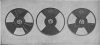
poem

Light and dark 

We know the light 

How well do we know the dark 

Like dreams 

A third of our life spent in them 

In film, 2 x 5ths spent in darkness 

Resting 

2 x 5ths is 40% , which sounds more than a third. It is. 

Sounds closer to half 

It’s hard to think of the agency in the dark 

That moves us in rest 

For 36 minutes in any 90 minute feature 

We remember all the changes and details in the light 

But the dark remains the same the whole time and we forget it completely 

Or do we 

Is the dark the other us 

Slumbering but listening 

Soaking up the dreams 

Making us what we become 

At the movies

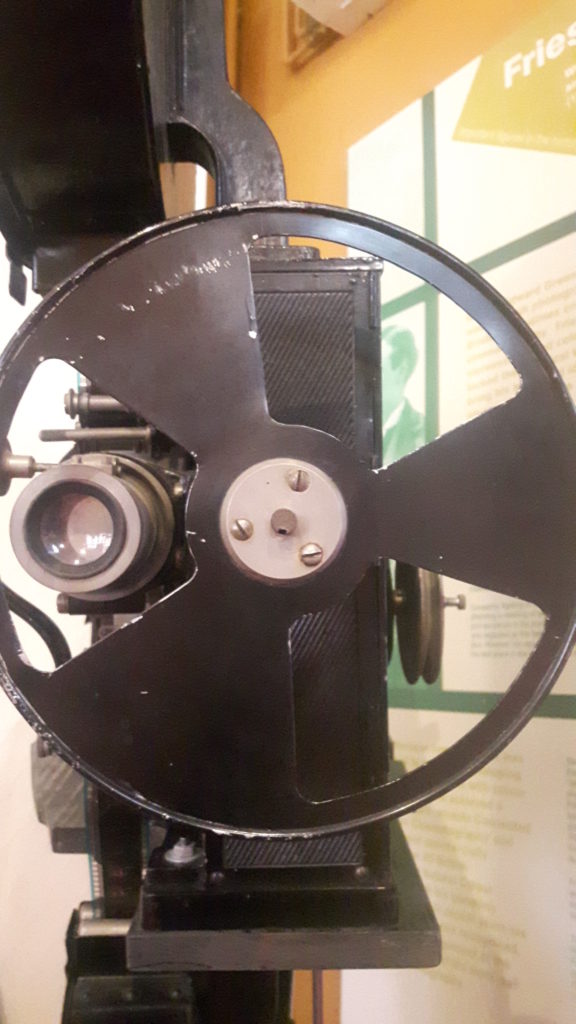
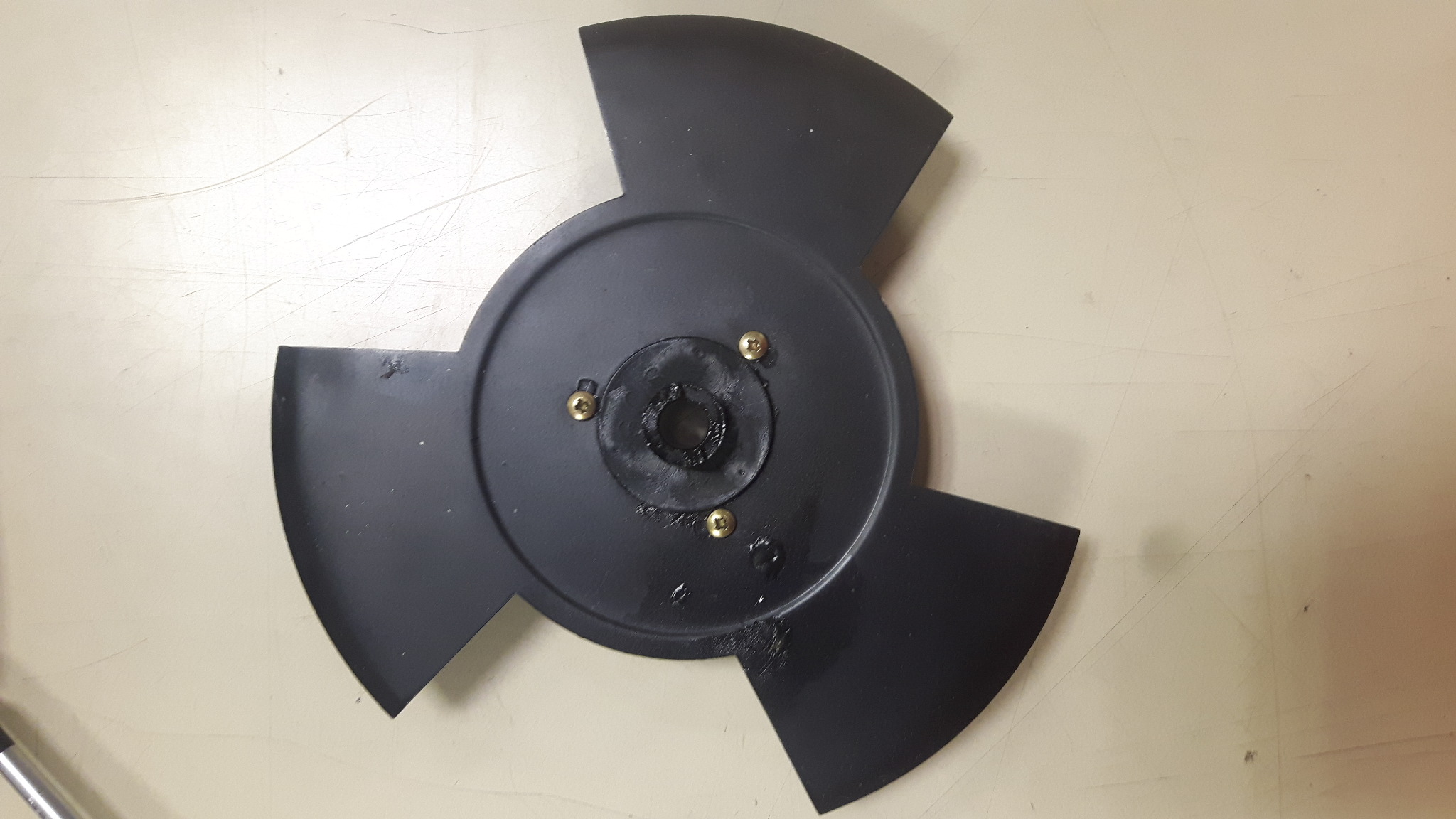
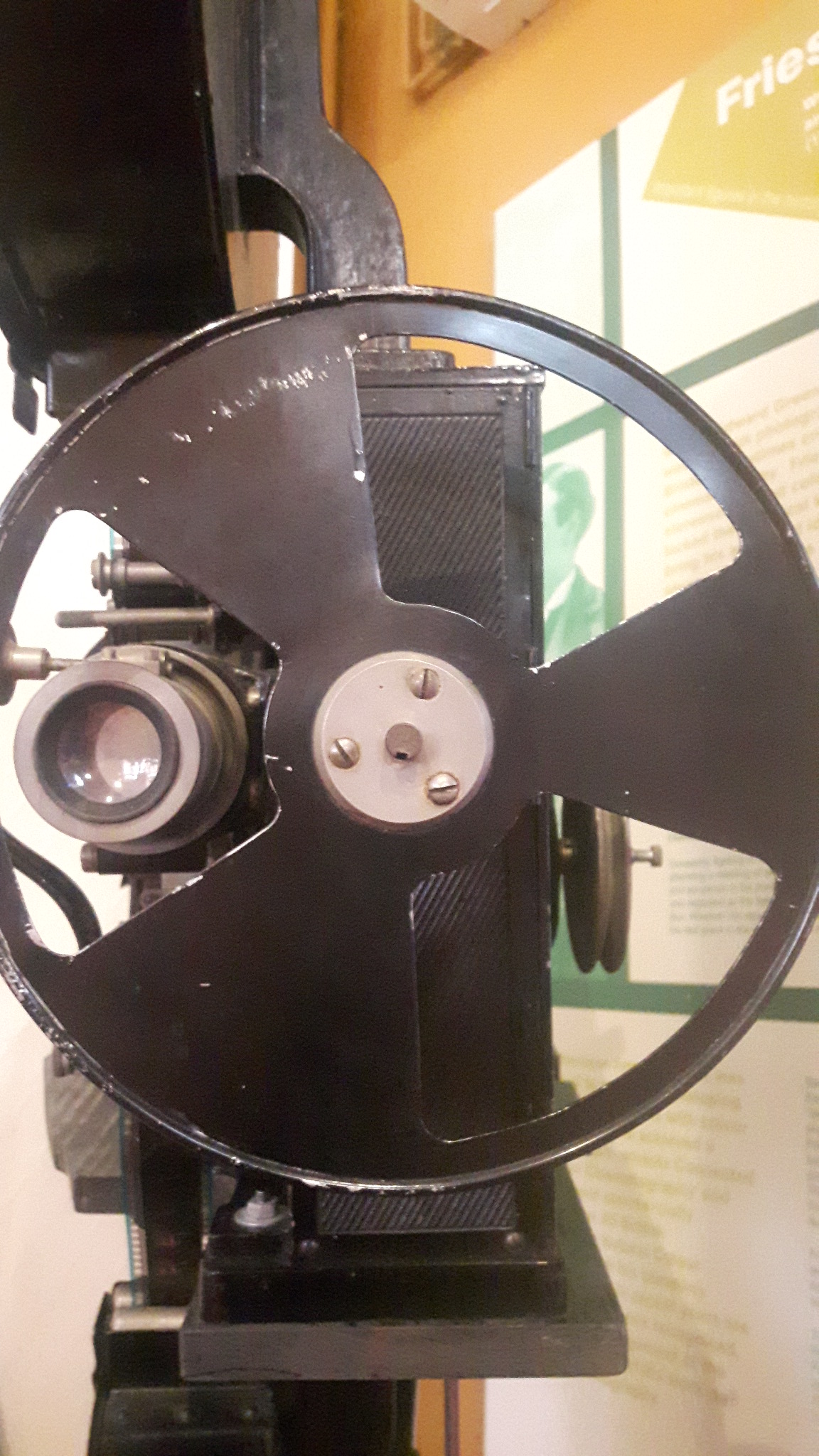
3 bladed shutter


What does a 3 bladed shutter do differently from a 2?

Nothing apart from project each frame 3 times, producing an image flicker frequency of 72hz.

A 2 bladed shutter produces 48hz.

If we chop off one of the blades in a 2 bladed shutter (not the pulldown mask obviously, unless we want this effect) we will get 24hz, representative of 24fps image acquisition rate.

To Come…..

next im going to measure the angles to see if its a 3:2 light/dark ratio.


projection frequency, angular and regular.


Im trying to devise a way of describing flicker that is mathematically accurate.

Frame rates as we understand them for example 24fps or 18fps are only one aspect of the whole picture delivery system. Firstly, often a frame is delivered twice, or three times so this produces a different phonomemalogical  figure, say 48fps. But this figure only counts the light portions of the flicker. If we count the (2 here) dark portions we now get another figure, 96hz, where I am now using hertz as the measure of regular intervals.Secondly frame rates are expressions of a previous event, the capture rate for the camera. So even though the frame rate is 24fps for example, the visual flicker phonomena is more involved.

There are 4 ‘events’ per second , giving the figure 96 worked out thus

1 second equals 24 frames.

each frame projected twice      48

each dark projected twice        48

total events per sec 4               96

OR

total events per second = 4 x fps (24) = 96

But this becomes problematic in silent film where the FPS figure is dynamic, or irregular, ie it changes very subtley over time.

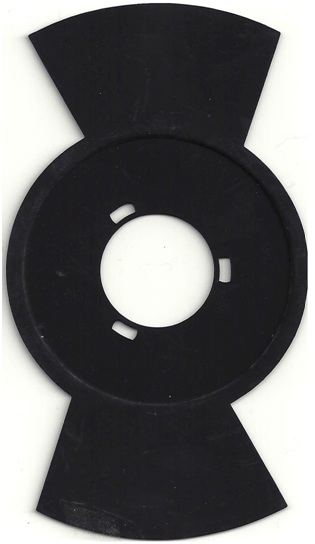
Also early film projection blades are highly experimental. Look at these two examples below.

The top one has a very uneven cycle. If we expressed this blade in terms of percentage of time open and closed it would look like this: (I always start with open on a new frame)

21 : 13 : 8 : 13 : 21 : 24

So open 21%, closed 13%, open 8%, closed 13%, open 21%, closed 24%.

Yes, we could say there are 6 events per second (also per rotation) giving us the figure for example for a silent film hand cranked at about 12FPS of 72hz.

In this blade though (interestingly) the total light and dark ratio is actually 1:1. If you add up the percantages you get 50% open and 50% dark. We know from other experiments I’ve done that modern blades on both 16 and 35mm projectors commonly have ratios of 3:2, light to dark, ie there is more light. This is what we want after all, more light, more image, better picture.

So this blade shows us in its form what the designers and engineers were thinking. They were perhaps stuck with thinking a 1:1 ratio was necessary but they experimented with different sized openings to increase flicker, including a very small light opening portion at step 3 above at 8% or 32 degrees. They also blocked out a large closed portion at 24% to possibly allow for turning of the intermittant. Im not sure as I’m away from the machine presently.

What is remarkable though is how ‘transparent’ this blade appears when you hand crank it and look through. You can see this in the bottom video.

So this descriptive form would be something like this

24 / 3:2 / 96hz
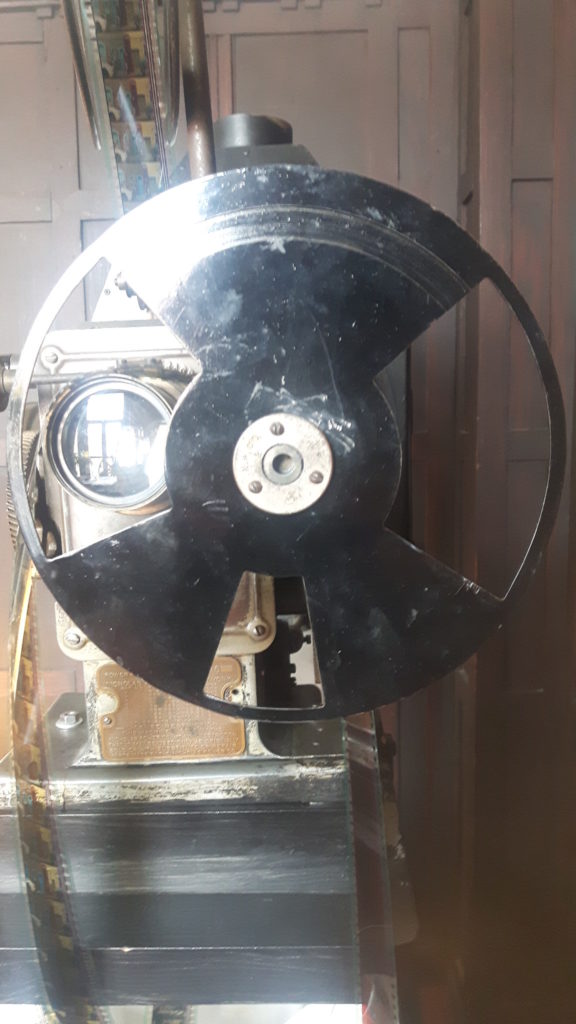


To delve into these problems more precisely Im going to have to learn about angular frequency and things perhaps like Radians and ‘turns’. 

http://mriquestions.com/angular-frequency-omega.html

https://www.mathopenref.com/radians.html

https://en.wikipedia.org/wiki/Turn_(angle)

Also, I want to bring in the camera blade into this at some point. The camera blade as we find it in early film cameras is a much more sophisticated system than the projector blade.  Firstly it is adjustable in real time. It can open and close whilst the camera is running which will change the exposure (say, creating a fade out) and but also the shutter speed resulting in say less or more ‘motion blur’. Early engineers and designers would have know its benefits and uses but this highlights the difference between capture and display.

Another key departure point between the camera and projector is the pull down method. The technique used to advance the film through the gate. 35mm cameras were often designed to run backwards. This feature was afforded by the fact that pins and claws were employed to make the transport happen and these contact points with the film worked well in the opposite direction. With a variable blade and bi-directionality we have a basic visual effect, the lap dissolve. FIlm with a fade out. Rewind film covering lens. Film on same piece of film with a fade in.

The projector however is typically employed in a strong forwards mode. Common 35mm intermittants (all the way upto modern ones) are turning gears which do not work or do not like to works backwards. They pull the film forwards but cant really push it back.

The 16mm transport system that we find in modern portable projectors (EIki/Elfs) however is a claw type mechanism. This method does work in both directions very well as I try to employ to creative and artistic ends with a projector that has been specially modified for me by an engineer.

In some ways, after the advent of the electric motor, we see a kind of ‘lock’ occuring to the visual system. This lock acts both as a standard to afford all of Cinemas producitons but also as a kind of base normaliser, or episteme even?

A reversible projector could be regarded as a different episteme alltogether from the one that underpinned 20th century film/cinema? Creative uses of a reversible projector in turn inform and message what is made with the reversible camera and almost certainly how the optical printer mediates in the centre of this axis.

In the reversible projector we see a different time. We experience an alternative mode of time form the one that is ‘motor’ driven. We still experience it IN TIME, but there now appears a sense of longer, almost timeless moments. A time that reveals hidden experiences that are covered over by the passing of time. Not the frozen image or the death still, revealing a synedoche of a given whole, but a dymamic anti-time that sheds and grows its skin of time during the experience in direct contingency to the time we think we are perceiving.

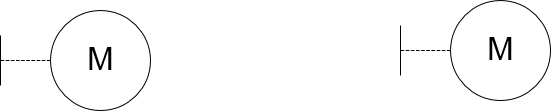
What is behind this in some way is an attempt to consider cinema from the POV of the electric motor. If we see the axis of mechanical expression as having its first system in cinema in the link between the hand cranked camera and the hand turned projector (not forgetting that electrical machinery must have been employed in the factory to engineer metal parts and machines) we see its end in the employment of the electrical motor as a ‘strictly governed’ device, ie a device that was under a ‘restriction’ to its creative freedoms. Filming speeds have been creatively employed from early on (high speed to stop motion) but projection motorisation has needed to be a standard in order for all other effects and applications to come into realisation.  The operation of the projector in expanded cinema (in a modernish sense, ie since the 1960’s) has done much to reverse this bias but its still possible to see the motor as an unquestioned rule that receives very little attenton in itself (exceptions would obviously be Bruce McClure and others).

What also interests me is the relation between the ‘work’ of hand cranking and the ‘work’ that the electrical motor ended up doing for us. For example in a common 16mm projector the motor is 500 watt (.74 HP) which equates to the work an athletic cyclist produces when they pedal.
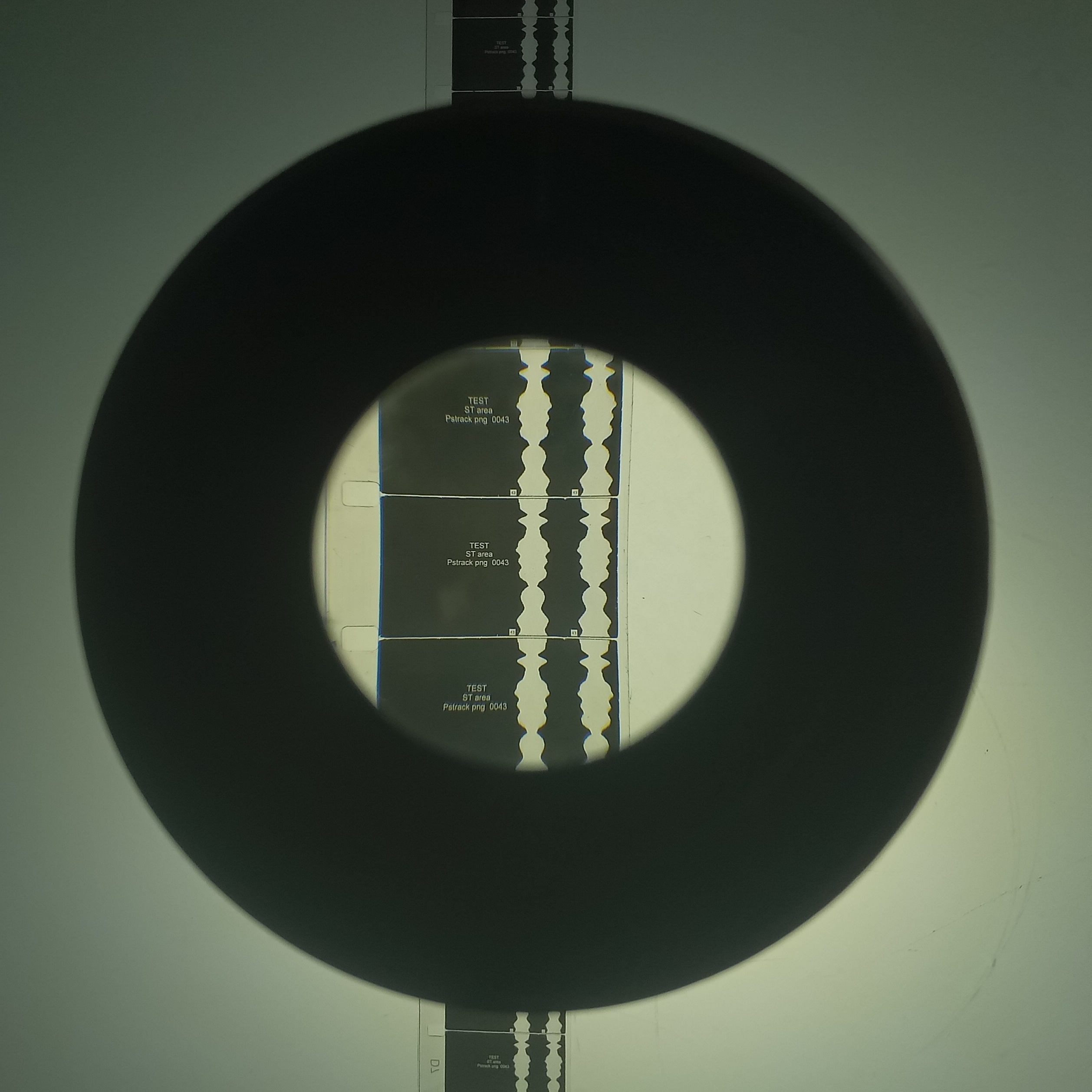
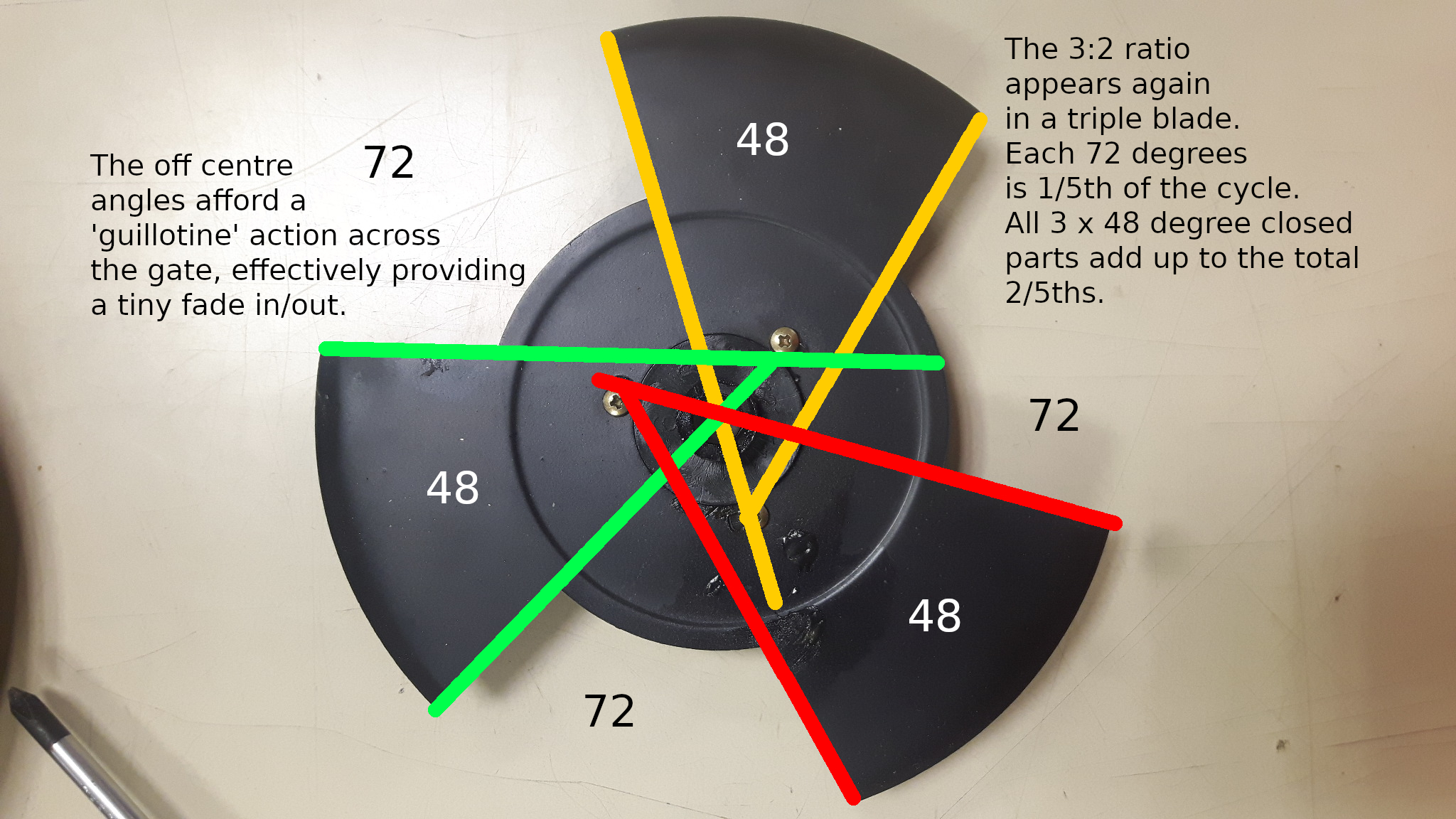


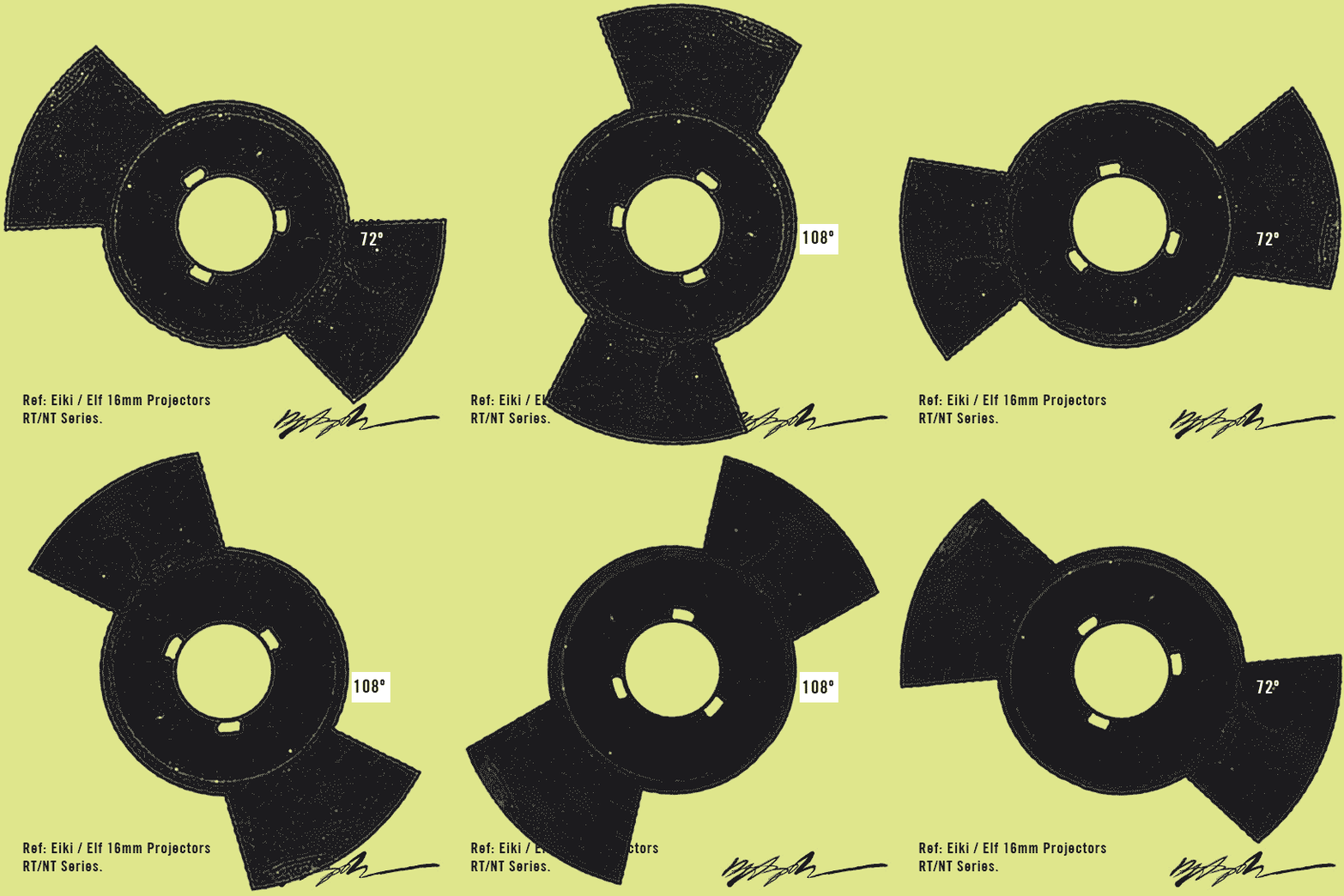
Eiki/Elf blade angles in action animated gif

Here are those  numbers again in their roles as light and dark. Both 108 and 72 have interesting cultural meanings which you can look up for yourself, my only advice being to tread carefully but open yourself to all kinds of wonder.

So, the magic number building block for the experiment to reinstate a virtual blade into digital versions of films shot on film is

3:2

The ratio of light to dark, as also proven by our filmed 35mm tests is 3 to 2.

60% to 40%. There is 40 per cent more image on screen in a digital version of a silent film.


108 and 72 the magic numbers for cinema blades.


In the video tests in an earlier post you can see high speed video of a projected 35mm image using a single aperture blade on a Kinoton.

After analysing the video its possible to say with some certainty that the RATIO of light to dark is 3:2 respectively. So there are 3 units (or steps, doesn’t matter) of light to 2 steps of dark.

This uses the 1200FPS footage which yields 50 frames/steps per real life second of time.

In this 50 step sequence 15 are light and 10 are dark, repeated again 15, 10.

If we want to now translate this to degrees, or angles to check against a physical blade we do it like this.

Each rotation of a blade in steps (or counts, just a measure unit) is 3, 2, 3, 2 which equals 10 units. 360 divided by 10 is 36.

To get the light count (3 x 36) we get 108 degrees.

To get the dark count (2 x 36) we get 72 degrees.

On a double bladed projector blade then the dark parts will be 72 degrees each and the light gaps 108 each.

On a single blade like the kinotons we add them getting 216 and 144.

Surprisingly there is VERY little fading in or out of the black. So in the 1200 per second video dark segment of 10 frames only the first and last frame are slightly dimmer. 

This means in action that the snap to dark and the snap to light happens in 1/1200 of  a second each. Not worth trying to mimic.

So the implications for my nitrate film digital flicker restoration is that we must see 3 frames of picture then 2 pictures of black. If the base frame count is 5 now, to run this clip at the speed of 13FPS (remember, my subjective speed choice) then the clips needs to run at 65FPS, 5 x 13.

As you were.

Oh, lastly the percentage then is 60% light 40% dark.


Analysing flicker on 35mm and DCP

FLICKER WARNING. THE CLIPS BELOW ARE STROBOSCOPIC AND FLICKER AT RATES THAT MAY DISTURB THOSE WHO SUFFER FROM PHOTOSENSITIVE EPILEPSY.

Heres some tests done using a high speed casio video camera aimed at the screen whilst projecting some 35mm.

The Kinoton used has a 180 degree blade so we need to get the data about how many ‘pulses’ per frame you get with this blade config. By 180 I mean this blade has only one opening for light and one for dark. So this blade must spin very fast to at least achieve 48hz which is roundabout the figure we need for flicker threshold perception.

What we will see is a pulsing of image and black.

Once we know the kinoton pulse frequency, we can work out data from the video image because each one is shot at different speeds, 300, 600 and 1200 FPS.

So say the Kinoton pulses each frame twice, so 48hz picture, 96hz image frequency, devised because each image is separated by black.

So each blade rotation has image – black – image – black, ie 4 stages. And 4 x 24 (overall FPS value is 96.

In one second (300 frames at slowest speed)  we should expect to see 48 image pulses separated by black. What I’m after is the curve, or fade in and out of the black and because the video will break that one second into 300 little parts, we can count them and see where and for how long the black occurs.


On the Casio, the pixel dimension of the image goes down as the speed goes up.

So the top one is 300, then 600, then 1200 fps at the bottom.

In each case, the frame counts for light and dark match the 3:2, division in 5ths rule.


More experimental virtual blades

FLICKER WARNING. THE CLIPS BELOW ARE STROBOSCOPIC AND FLICKER AT RATES THAT MAY DISTURB THOSE WHO SUFFER FROM PHOTOSENSITIVE EPILEPSY.

The purpose of these experiments is to regard the intrinsic opto-mechanical mode of presentation of motion picture film as if it was important to the overall ontological nature of ‘cinema’ which would include really the camera (also opto-mechnical) and various laboratory devices which affect the film in between.

Regarding them as important enough to simulate their ‘effect’ as we transition the image sequence into the digital realm means going back to the model of its ontology and producing as accurate as possible a virtual equivalent.

3 bladed shutter

In many respects, we are already fully acquainted with ‘bladeless’ ‘flickerless’ digitised motion picture sequences. We like them because they are clean and pleasant to watch. We see loads of detail and are left finally to respond to them as art and poetry. They really have become a ‘model image’.

So hauling over the entire mechanism that produced them has to be done with a slight amount of tongue in cheek. Its really an experiment designed to make us aware of the fundamentally different nature of analogue and digital but through the agency of the current mode, digital, and its materiology and limits, parameters and properties.

270-90-degree-sequence


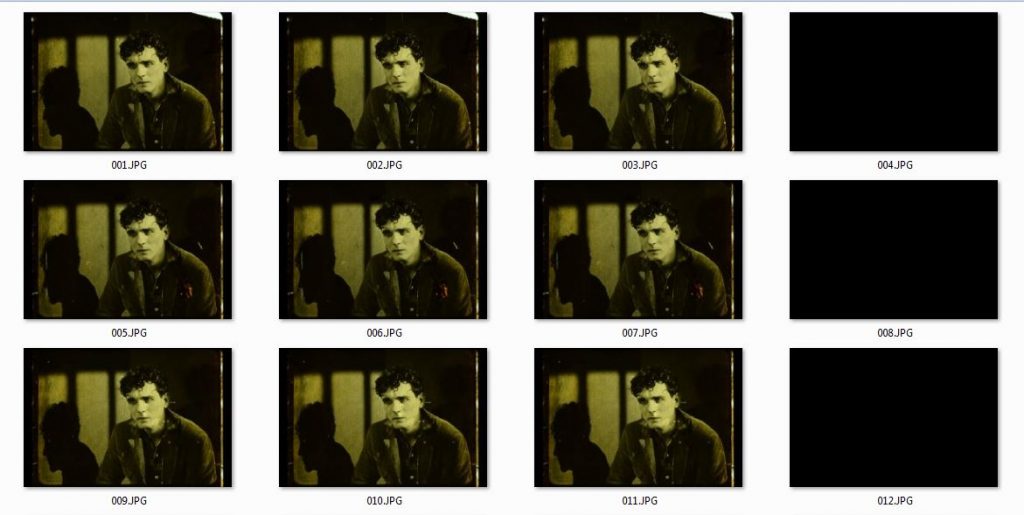
Above shows the frame sequence for the 270-90 degree blade tests. Each line represents one rotation of a virtual blade. We get the same image 3 times, then we get 1/4 of that period as black. (1/4 = 90 degrees right??).

We can repeat an image 3 times without flicker (if its the same image) because we are now using the instantaneous display possible in digital to our advantage. In an analogue system this image isn’t repeated as such, its just onscreen for LONGER, 3/4 of the time LONGER but we are using frames, we have to use frames because in digital there is no blade, so we are creating one.

Here’s a first conversion. You can detect immediately how much more brighter it is. But first the old 90×4 one. Remember, the one with equal pauses of black and image.


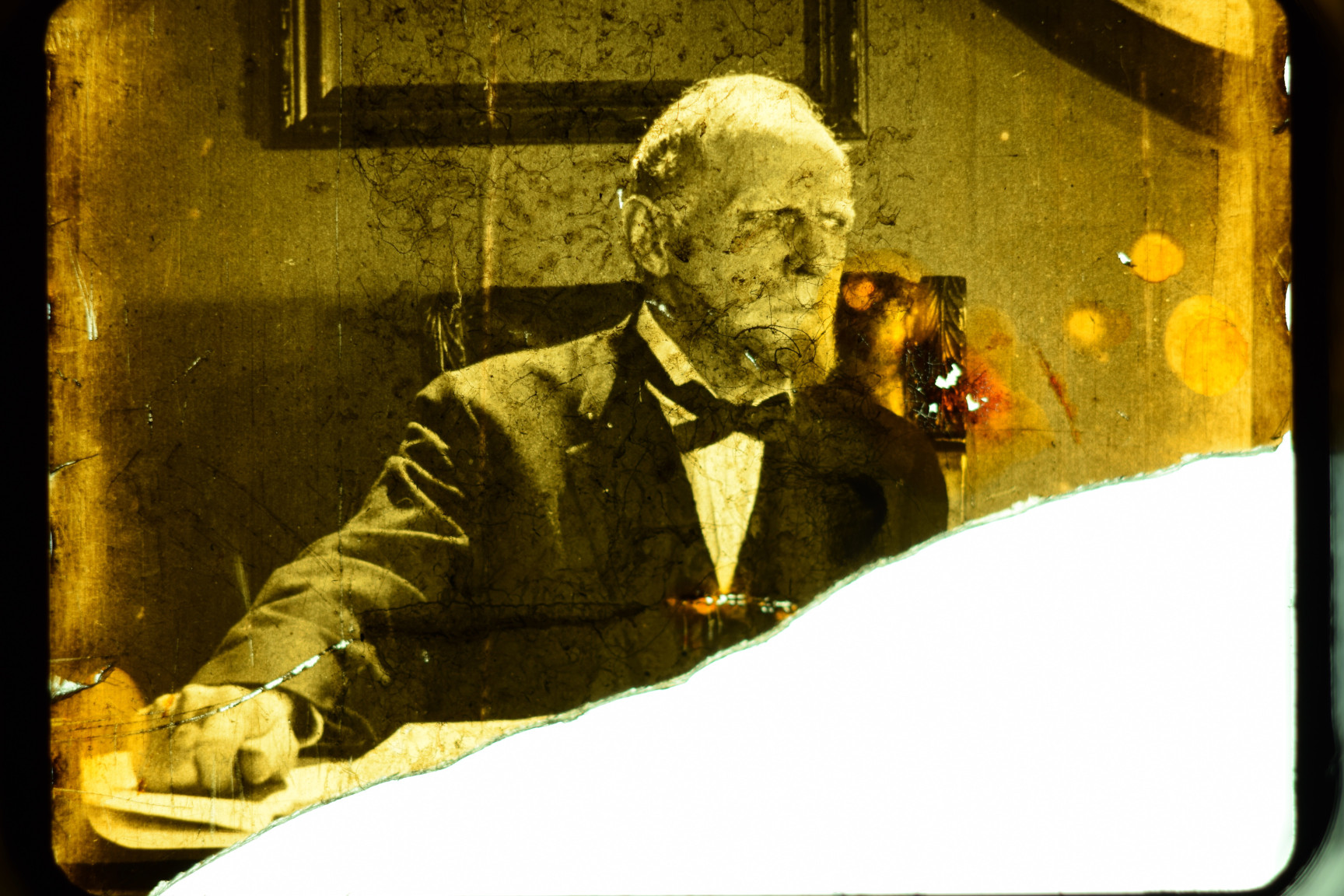
Is is possible the woman is Virginia Valli and the man Francis McDonald? Thanks to Kevin Brownlow for this via Andrew Hobson who visited the Cinema Museum recently.

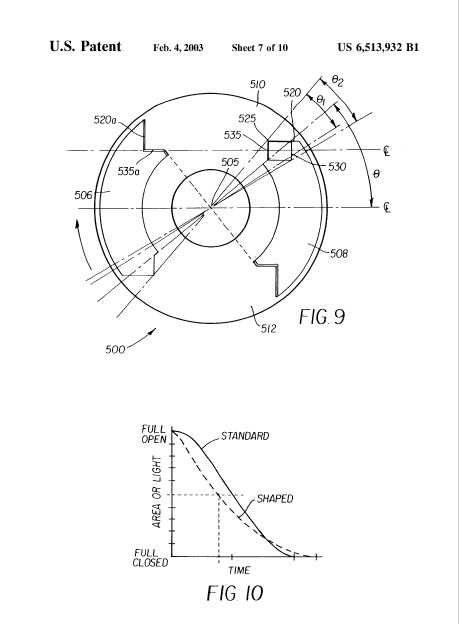
Below is a different kind of shutter I found in the US patent office. Here a ‘shaped blade’ allows more light to pass by delaying its effect til the very last moment.


The Ghosts of Analogue in Digital

FLICKER WARNING. THE CLIPS BELOW ARE STROBOSCOPIC AND FLICKER AT RATES THAT MAY DISTURB THOSE WHO SUFFER FROM PHOTOSENSITIVE EPILEPSY.


When we view a digital version of a work of early cinema our experience is notably different from when it would have been (could be)  seen opto-mechanically. Of course  digital viewing systems, whether DVD and CRT screen, Blu-Ray and HD TV, or even a cinema DCP,  all offer  different types of overall screening experiences partly through the agency of their personal nature as well as purely in terms of ‘image’.

But the very basic and intrinsic phenomena  of flicker in opto-mechanical projection is so fundamental to that viewing experience that it seems a shock to learn that in digital versions of those same films (ie most silent films that are “restored” and viewed digitally) the flicker image, the image of the closed blade, the black, the resting place for the eye, the moving part of the moving image is entirely absent. In these digital versions the empirical qualitative image experience (you could argue) is significantly (perhaps radically) different from the original ‘kind’ of experience. In a way an instrumental trace of the projection apparatus has been ‘removed’ and perhaps becomes denied.

Enough to justify it being considered  ‘impossible film’?

That is, in digital versions of silent (and other types) cinema, you are viewing an ‘impossible-to-history’ kind of image. It would and could have never been experienced that way.  Modern revival, (re)discovery and cultural examination of silent cinema forms is largely possible, motivated and contingent upon this digital alteration and the access and qualitative possibilities it open up.

To try and illustrate this radical difference permit me to indulge………………..


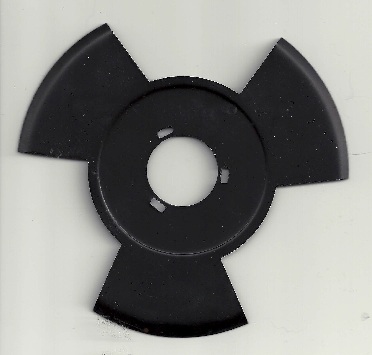
This shutter from a 16mm projector shows 2 periods of dark and 2 periods of light. They are unequal but for the moment forget about this. Each period of light projects the same image frame. In 2 bladed shutters like this the frequency of the flicker is 96hz if the film frame rate is meant to be 24 fps. In one period of darkness the claw moves to its new position. In the next period of darkness the claw engages the film and pulls it down. In a 35mm intermittent type mechanism (driven by maltese cross) the second period of darkness is for the purpose of flicker stability as the pull down happens completely in one period of darkness. In every single rotation of the blade we get –  frame / black / frame  / black. 4 pulses if you like and 24 x 4 = 96. This is why the following tests are called Quad tests. They are attempts at producing a virtual digital blade that repeats each picture twice with 2 closed/black periods.


This clip, after many tests with the fps speed look about right at 13fps (see previous post).  Here’s the clip, digital assembly from a single jpg  scan or each frame, running at 13fps.


Heres the clip with a QUAD structure. That is 2 picture frames and 2 black frames. 13 x 4 = 52.

So the movement that the actor makes is the same speed as above, but there is now truck loads of flicker, 52hz to be precise, 52 changes per second.

Firstly, almost before the flicker you notice how much darker it is. Well this could be down to your screen, or the ability of any LED screen to reach full brightness after full blackness. It could be a perceptual issue as if you download the clip and watch a frame at a time it looks brighter.  None of these scans have had levels adjusted so later on we could compensate by boosting brightness, etc.

Next clip says 39hz. 39 / 4 =  9.75. So the FRAMERATE for this test is 9.75fps but the frequency is 39hz.


Lastly, clip 3 shows 26hz. 26 / 4 = 6.5 fps. This very slow, but still a reasonable speed to turn a hand cranked mechanism if you were not very fit or were not used to it or both.


After watching these clips over and over again, apart from hallucinating and becoming mildly obsessed, I actually begin to feel the presence, beyond the flicker, of the projection mechanism. They are kind of jerky, on my PC they don’t run smooth and in clip 39hz the converter I got did a bad job of it with glitches and pixels everywhere. But, still, in there somewhere is the ‘feel’ of a projector. The rhythm and the pulse of the machine, the projector.

Next I’ll be working on uneven percentage virtual blades. That is blades where say instead of 90/90/90/90 degrees as in these QUAD tests, we will try 135/45/135/45 degrees where the 135 is picture frames. Of course we know enough about physics to know that the picture, its brightness and perceptual fidelity will start to increase. Now I’m off to prepare for human extinction. All the best!

Here’s a link to a folder with the files to download if you wish.

https://www.nachleben.org.uk/skomer/man-uploads/RESOURCES/VIDEO-FILES/QUAD-TESTS-flicker/

Here is 2 cycles of these tests, regardless of the frame rate. Each cycle (of the virtual blade) we get – picture , black, picture, black. The same picture projected twice in each cycle (like a 35mm 2 blade shutter). To create a 135/45 or more accurately a 270/90 shutter, the sequence will be picture, picture, picture black – picture, picture, picture, black. Several configurations will be tried until we get to the one most closely looking like film projection. Then the last detail will be working on the ‘knee’ or tiny fade ins/outs that soften the ‘cut’ between frames. This digital discrete frame ‘cutting’ is like square waves and that’s not how it works in practice. Film blades cut quickly, but not instantly. It remains to be seen how this can be measured.


End note.

Personally, for me (not without a modicum of irony) I actually enjoy the digital versions the most.  Accepting the materiology of the medium and its own specific nature (impossible film?) frees the film (model image? The strip, manually beholden) from the projection mechanisms effect of flicker BUT, and more importantly ‘allows’ the perception of a new flicker, that produced by uneven light levels (effect of hand cranked camera) and the grain, noise, dirt, damage and wear that are all materiologically bound to the nature of the film strip. I mentioned years ago during a symposium in Amsterdam that watching scanned/digitised early footage was like seeing film ‘on a stretcher’.  You can see more.


Do check out the wonderful Curzon Cinema in Clevedon where this film was found and the detective hunt is on to try and identify it and the players who feature in it.