Hello.
Optical printers are traditionally slow to operate. Being devices that require careful setting up. The keeping track of many moving parts simultaneously results in a reputation as an arduous process. However I approach them differently. I think of them as a camera. An animation camera yes, so single frames are the shooting mode, but, as I recently discovered you can get work made quickly as long as you free up the thought that goes into what you are doing.
As there is a frame by frame metric afforded by the seperation of projector gate/film and camera gate you can think more of the sequence you are shooting as made of building blocks where each block is a frame. 24 shots of the same frame will be a second of a frozen frame. If you cap the lens for 3 frames, you will get a dark spot*, if you cap it for 1 frame between shooting that same frame again this time for 48 frames you will get 2 seconds of flickering image/black, the fastest flicker possible on film running at 24fps.
On/off, On/off, on/off, on/off, etc.
*of course you will get a bright spot in the OP print itself because no light reaches the film and it devleops clear. BUT, all this is being done knowing that after the OP print is developed, it will be contact printed.
If you now cap the lens for BETWEEN 1 frame and 4, 5 or 6 frames, just making it up as you go along, and also do the same for the frame, ie sometimes shooting it once, sometimes 4 times, sometimes, 3 or 6, then you will get a flicker that stutters and varies, it can seem almost musical.
You will soon rack up a master camera frame count.
Now, if that frame in the gate is number 1 (you can accurately number frames in a sequence by previewing and making note of their numbers) you can now goto a different frame, say 13 and then shoot in the same manner as above. You can pause, goto a random frame in your sequence, and shoot in above manner. You can shoot some frames only once deliberately, you can run others for seconds, hold off on flicker, bring flicker back in…..etc. That frame count is going up, you will soon get to 1000 frames, 25ft, which is a good length of material for somekind of expanded cinema performance.
This is all exactly what I did with these loops (video above) where you see them side by side, then overlayed. In total it took a day. Including the contact printing.
After I’d made it to about 25ft I processed the optical print and then contact printed it. I then selected a very short length of them both, exactly the same bit in neg and pos and laced the loops into projectors set for 18fps.
The original material that was in the optical printer projector gate was black film that had been melted in my friend Manivelle. I melted a length of film, not every frame and also I used both sides, emulsion and base. I melted some heavily and some only just get burnt. The film is black print film that has no image. The melting and heat have the effect of making the image. Many kinds of image are made this way, infact, they are like fingerprints or snowflakes, every one seems different. The heat of the lamp in the Eiki projector, the good old halogen xenophot 250w-24VDC is the agency of the heat and focus and thus the cause of the melting and thus the author of the image. Each image is a tiny moment of thermodynamics and plastic in a state of rapid destruction. All films burn differently. Old black and white films leave a brown dis-colouration, some colour films hardly melt at all, then burst into a pyschedelic nebula of bubbling chaos. But for now, im just exploring pure melted-film on black imageless film.
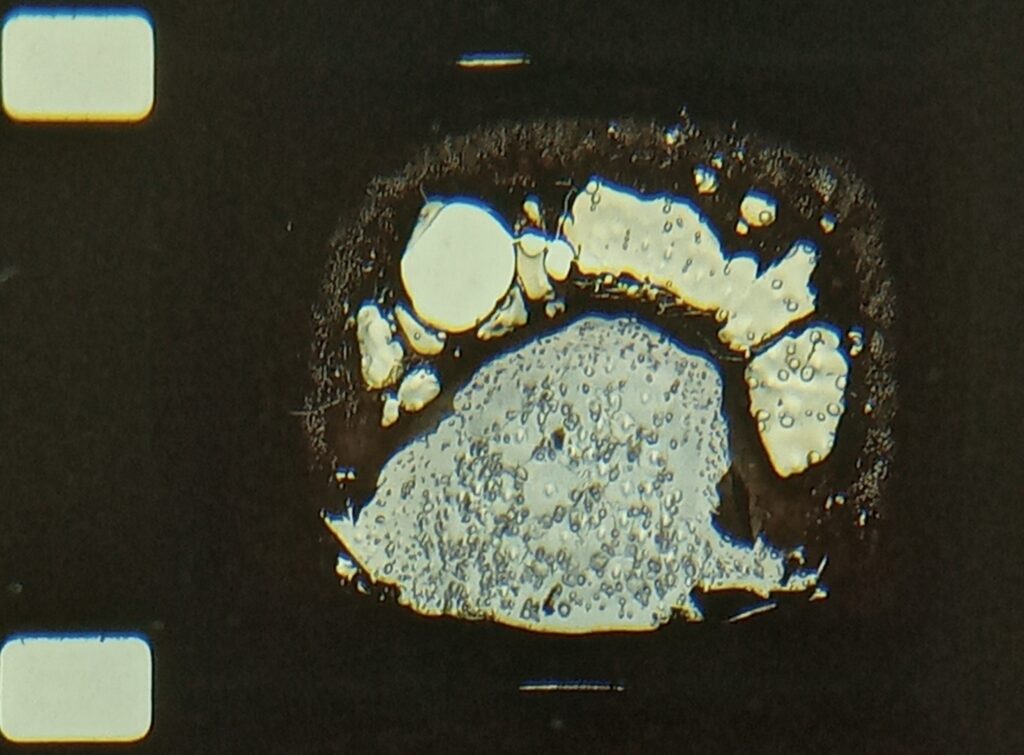
Manivelle is of course a performance Eiki. She allows close contact between the frame in time and the sequence in memory. The motor having been removed forces a new relationship between the film strip as slide show and the rapid slide presentation of film as moving image. Manivelle also allows a precise backwards motion! The melting film, when it is allowed to happen is a real occurance. It happens outside of frame rate or resolution. So these above experiments are a further exploration of live melted images, their forms now recycled as ‘representative’, ‘illusions’ possibly OF something that was real, once.
So just as you can (and many people do) use a Bolex in single frame mode, counting, rhyming, triggering, thinking in ones, repeating, you can also do the same with the optical printer, the only difference is that you have a pre- selected array of images to put in the gate.Or perhaps you haven’t thought about this at all and have grabbed a load of random clips. Maybe you are printing loads of random b/w clips to colour (like 3383) using another random pallette of coloured gels!!
If you wanted to pre-plan a precise, musicalish score, you could write all the counting down on a chart with a column for projector and column for camera, thinking and devising in a more comfortable and relaxing space. Then coming into the territory of the OXBERRY and thrashing it out!! Its not optical printer that are slow, its the way that we use them.